

📘 Overview of Atoms
👉 Summary
Atoms positions itself as an AI “team” for building websites and apps, not just a page generator. The promise is to remove friction between an idea and a publishable asset. Instead of assembling sections manually, you provide a clear brief—audience, value proposition, key pages and conversion goals—and the platform produces an initial version you can refine. What makes this interesting is the end-to-end loop: planning, generation, editing and publishing. For early-stage builders, marketers and small teams, that means you can ship a launch page, a waitlist, or a simple web app quickly, then iterate based on feedback. This profile explains what Atoms is, the most important features, common use cases and the key pricing considerations to avoid surprises when usage scales.
💡 What is Atoms?
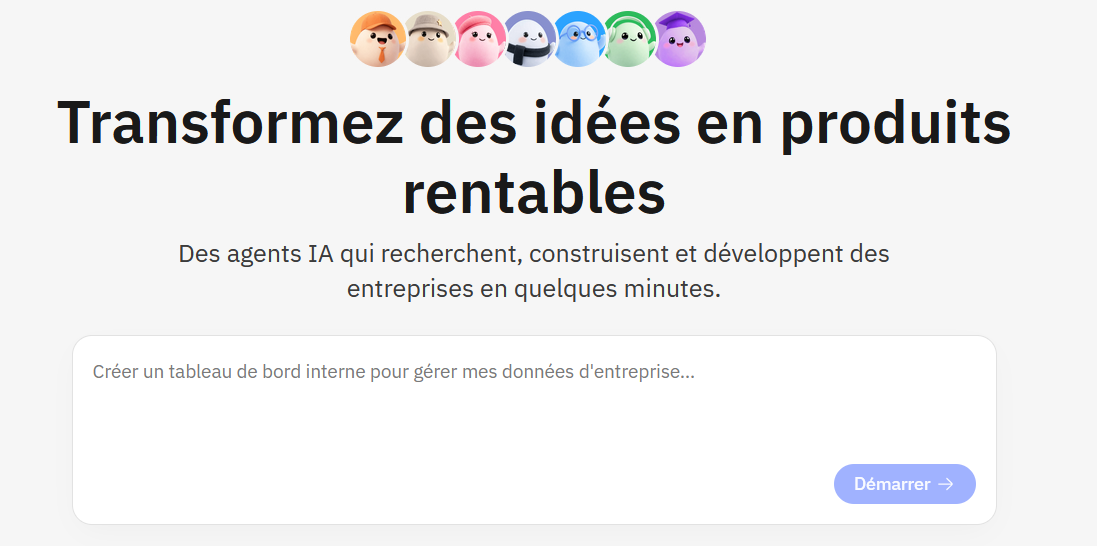
Atoms is an AI-powered website and app creation platform built around a multi-agent workflow. The product uses specialized agents to help with research, structure, copy, page generation and project assembly. Users describe their product or service in natural language, review the proposed structure and iterate through an editor. The platform is designed to help individuals and small teams turn ideas into publishable outputs—launch pages, simple sites, and early-stage app prototypes—without requiring a full development team from day one. Atoms combines generation, editing and publishing in one place, with paid plans that expand credits, storage and production options such as custom domains and heavier compute resources.
🧩 Key features
Atoms focuses on speed to first version and fast iteration. The workflow starts with a guided brief: you specify your audience, what you’re building, the key pages and flows, and what outcome you want (waitlist signups, demo requests, purchases). Atoms then proposes a sitemap and generates a first pass of pages and content. Editing is a core component. You can refine copy, adjust sections, tweak layout and update CTAs so the result matches your brand voice and conversion intent. This generation-plus-edit loop is where most users get value. Atoms also emphasizes a multi-agent approach: instead of a single assistant, different roles can contribute to planning, structure, and execution, producing more complete outputs and clearer project organization. Finally, publishing capabilities allow you to host and update the product. Depending on the plan, you may unlock private projects, downloads, badge removal, more storage and higher compute for heavier builds.
🚀 Use cases
Atoms is a strong fit for launch pages and product announcements. Startups and indie builders can generate a clear landing page with value proposition, benefits, social proof, FAQs and a waitlist form, then publish quickly to capture demand. A second use case is MVP prototyping. Atoms can help outline screens and flows, generate an initial build and provide something you can demo or pre-sell. This works well when you need speed and learning over perfect customization. Freelancers and small agencies can use Atoms to deliver simple marketing sites faster, while keeping an editing phase for client feedback. Finally, Atoms supports iterative messaging work: you can test different positioning, update CTAs, add sections, and keep the published site current as your story evolves.
🤝 Benefits
The main benefit of Atoms is speed. You can go from a brief to a usable draft far faster than with traditional builders, shortening the loop between idea, launch and learning. Second, the multi-agent planning and structure help non-technical users produce more coherent pages that communicate value and address objections. Third, iteration is straightforward. Editing and republishing makes it possible to operate like a growth team: test messaging, refine conversion paths and update quickly. For small teams, the platform acts as a force multiplier: more launch pages, more experiments and faster prototypes without immediately increasing headcount.
💰 Pricing
Atoms offers a $0 free plan with a credit system suitable for light usage. For regular work, the Pro plan starts at $20 per month, with higher credit tiers available as usage grows. A Max plan starts at $100 per month for intensive needs. Because the model is credit-based, it’s important to estimate how often you generate and how many projects you maintain. A single launch page plus occasional edits may fit within Free or Pro, while frequent generation across multiple projects can justify higher tiers. A practical approach is to test on Free, track credit consumption during real workflows, and then choose the tier that matches your monthly build and iteration cadence.
📌 Conclusion
Atoms is a compelling option when your priority is to ship quickly: launch pages, marketing sites and early MVP prototypes that can be published and iterated fast. The multi-agent approach and the generation-edit-publish loop make it well-suited for founders and marketing teams. For technical teams, it can be a prototyping accelerator, but you should validate customization limits and platform dependence before committing to complex products. In short, Atoms is a “launch engine” for fast market tests and iteration—excellent for speed, and best evaluated carefully for enterprise constraints or highly bespoke applications.


